Chandra Bhat’s Academic Gift: Inspiring Students to Improve Urban Sustainability
The professor is recognized as a leading expert in the area of travel demand modeling and travel behavior analysis.
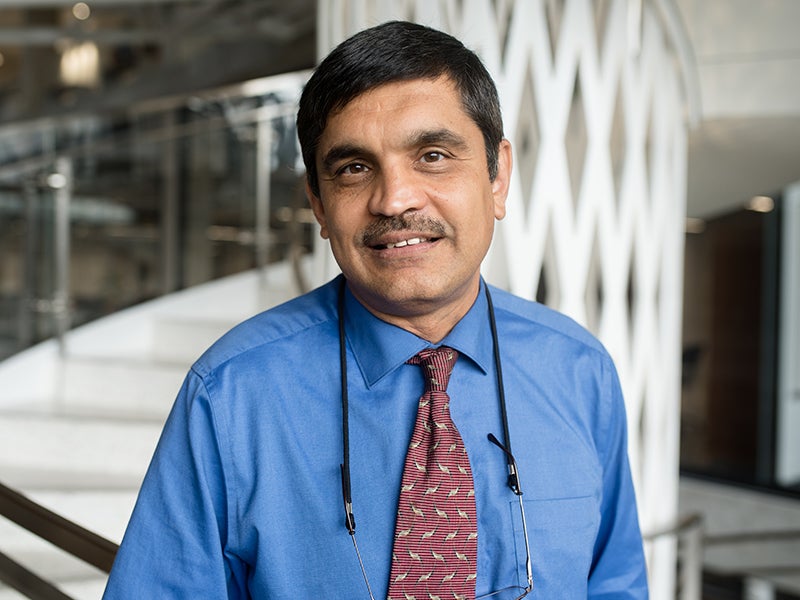
Professor Chandra Bhat
Dr. Chandra R. Bhat is the Adnan Abou-Ayyash Centennial Professor at The University of Texas at Austin, where he teaches courses in transportation systems analysis and transportation planning methods. He is recognized nationally and internationally as a leading expert in travel demand modeling and travel behavior analysis.
How did you become a professor?
After completing my Master’s, I began working in the industry. That was an excellent decision, because it very quickly made me realize that I had to be involved in cutting-edge research. So, back I went to complete my PhD, and I had made up my mind right then that I wanted to be a professor at a university.
Can you discuss your current research?
The transportation field impacts, in both direct and indirect ways, the well-being of humanity and the economic/social vibrancy of society. My specific subject area of transportation research focuses on analyzing the activity and travel behavior of households and individuals within the context of sustainable urban planning, public health improvement, flexible and resilient transportation planning, and efficient energy use. In particular, a good understanding and prediction of the activity and travel behavior of individuals is critical to evaluating the effects of alternative traffic congestion-alleviation strategies, such as work rearrangement measures, transit service improvements, congestion pricing schemes, and real-time traveler information systems. Individuals and households are likely to respond to such strategies in a complex manner. My research predicts these complex responses by modeling individuals’ activity and travel choices, including where they live and work, the activities they participate in, their travel methods, travel schedules, and destinations, thereby facilitating the identification and implementation of effective transportation policy actions. As importantly, my research provides input on crucial global policy issues related to energy use and dependence, economics, greenhouse gas emissions and climate change, urban sustainability and transportation security.
My research is particularly relevant to long-term transportation planning in today’s rapidly changing demographic profile of the US and world population. For instance, the population is aging and the mobility needs of such an aging population have to be anticipated in advance for good infrastructure investment decisions. Methodologically speaking, my research efforts are in the areas of number theory, econometrics, microeconomic theory of consumer behavior, and consumer choice modeling.
What are the most significant successes or proudest moments of your career?
I have been fortunate to receive several research and teaching awards during my career. While I am humbled by receiving these awards, I am particularly happy when I am appreciated for my teaching. It is certainly gratifying when I receive notes from students indicating how much they enjoyed a course I taught and/or how much their future career aspirations have been influenced by interactions with me. However, my proudest moments are when my graduate students receive awards for their master’s or Ph.D. research under my guidance.
In each of the years 2000, 2001, and 2009, one of my students was awarded the prestigious Milton Pikarsky Memorial Award for the best thesis in North America in the field of transportation. In 2004 and again in 2008, one of my Ph.D. students received the Charley V. Wootan Award for the best North American dissertation in the field of Transportation Planning and Policy. In 2009, a Ph.D. student received an honorable mention in the international Eric Pas Prize Competition for one of the top two dissertations in the field of travel behavior.
In 2005, and once more in 2008, one of my students received the Robert Herman Award for the best doctoral student in the South West University Transportation Center region, based on research and leadership. In 2007, I co-authored a paper with students that received the 2007 Pyke Johnson Award from the Transportation Research Board (TRB) for the most outstanding paper in the field of transportation systems planning and the environment. My students have been selected for the Eno Leadership Program, the International Road Federation (IRF) Leadership Program, the Eisenhower Graduate Fellowship, the Wanda Schafer Scholarship of the Women’s Transportation Society, and the Herman Award, among other awards. Overall, since 2000, my students have received 30 external (non-UT) awards for scholarly research.
I was also honored to be selected for the prestigious 2008 Jefferson Science Fellow (JSF) program, coordinated by the US Department of State. The program’s purpose is to engage the American academic science, technology, and engineering (STE) community in the formulation of the US government’s foreign and domestic policy.
Please share a favorite memory of your time at UT CAEE.
Playing basketball with transportation graduate students and participating in intramural basketball matches with students.
Are you involved in any organizations outside of work?
I was a basketball coach for several years for a girls’ team at the Town and Country League here in Austin.
Do you participate in any outreach programs or help out with student organizations?
I am the advisor for the UT Institute for Transportation Engineers (ITE) student group. I was awarded the 2008 Outstanding Faculty Advisor Award by the Texas Institute of Transportation Engineers, in recognition of “leadership in advising the UT ITE student chapter and guiding the next generation of transportation engineers.” I have participated as a faculty mentor in the Freshman Fall Honors Colloquium, and have served as the departmental representative on the Equal Opportunity in Engineering (EOE) College Committee, which organizes the World of Engineering (WOE) and the My Introduction to Engineering (MITE) programs.
In addition, for several years now, the Chi-Epsilon Student Chapter has held a Fireside at my home, allowing them to learn more about transportation research and practice. I also routinely advise and assist Civil Engineering undergraduate students on their transportation projects for the Technical Communication (CE 333T) course. For example, I have worked with an undergraduate student to apply transit accessibility software to examine the potential enhancement of transit access for mobility-challenged segments of the Austin population due to the introduction of the commuter rail transit system in Austin. Other current transportation issues I have worked on with students include signal coordination and progression issues on arterials in and around the University of Texas (UT) campus, the effects of tolls and pricing strategies on Austin highways, and the impact of freeway access/exit ramp reconfigurations on traffic patterns.
Finally, I have been managing the Undergraduate Summer Internship Program in Transportation at UT for over 8 years. A group of talented undergraduate students from various US universities is nominated, selected, and invited to Austin to spend the summer working on research projects under the mentoring of UT faculty and graduate students. This program has been successful in attracting top-quality students to the field of transportation. Many of these undergraduate students have proceeded to become transportation graduate students or employees at regional/state transportation planning agencies.
Do you have any advice for students?
Enjoy your time as students and seekers of knowledge. Learning is fun, and, as a student, you are able to devote full time to it! That’s such a luxury, so enjoy it.