A New Civil Engineering Startup Ecosystem Takes Shape
The inaugural Maseeh Innovation Competition aims to empower the next wave of entrepreneurs.

The Fariborz Maseeh Department of Civil, Architectural and Environmental Engineering has teamed up with the Texas Innovation Center to inspire and empower the next wave of entrepreneurs through the Maseeh Innovation Competition.
This first-ever, multi-stage event unites students from a wide range of disciplines to turn bold ideas into sustainable business ventures. Throughout the competition, CAEE participants collaborate with fellow UT students and business mentors across the Forty Acres to refine concepts and develop compelling pitches.
“The Maseeh Innovation Competition empowers students to develop innovative, real-world solutions to critical challenges in infrastructure. Aligned with the department’s strategic vision, the competition promotes interdisciplinary collaboration and entrepreneurship, enabling students to move beyond technical concepts toward deployable solutions with societal impact,” said Javad Mohammadi, program lead and assistant professor in the Fariborz Maseeh Department of Civil, Architectural and Environmental Engineering.
The inaugural event kicked off this fall with networking opportunities for students to engage with faculty, alumni and industry leaders as they prepared for the first round of the competition. Four finalist teams were chosen from the first round, which required the teams to submit a short video and an executive summary of their concept.
From the pool of participants, four finalist teams were chosen to receive $1,000 to steward customer discovery efforts to inform a final pitch presentation, which will take place on March 26th.
As the final round of the competition approaches, we recently spoke with the finalists about their technologies and what they’ve taken away from the experience thus far.
Team TX Filter
Team members: Evan Segura (Cockrell School of Engineering – Environmental Engineering) and Jacob Lucia (McCombs School of Business – Accounting)
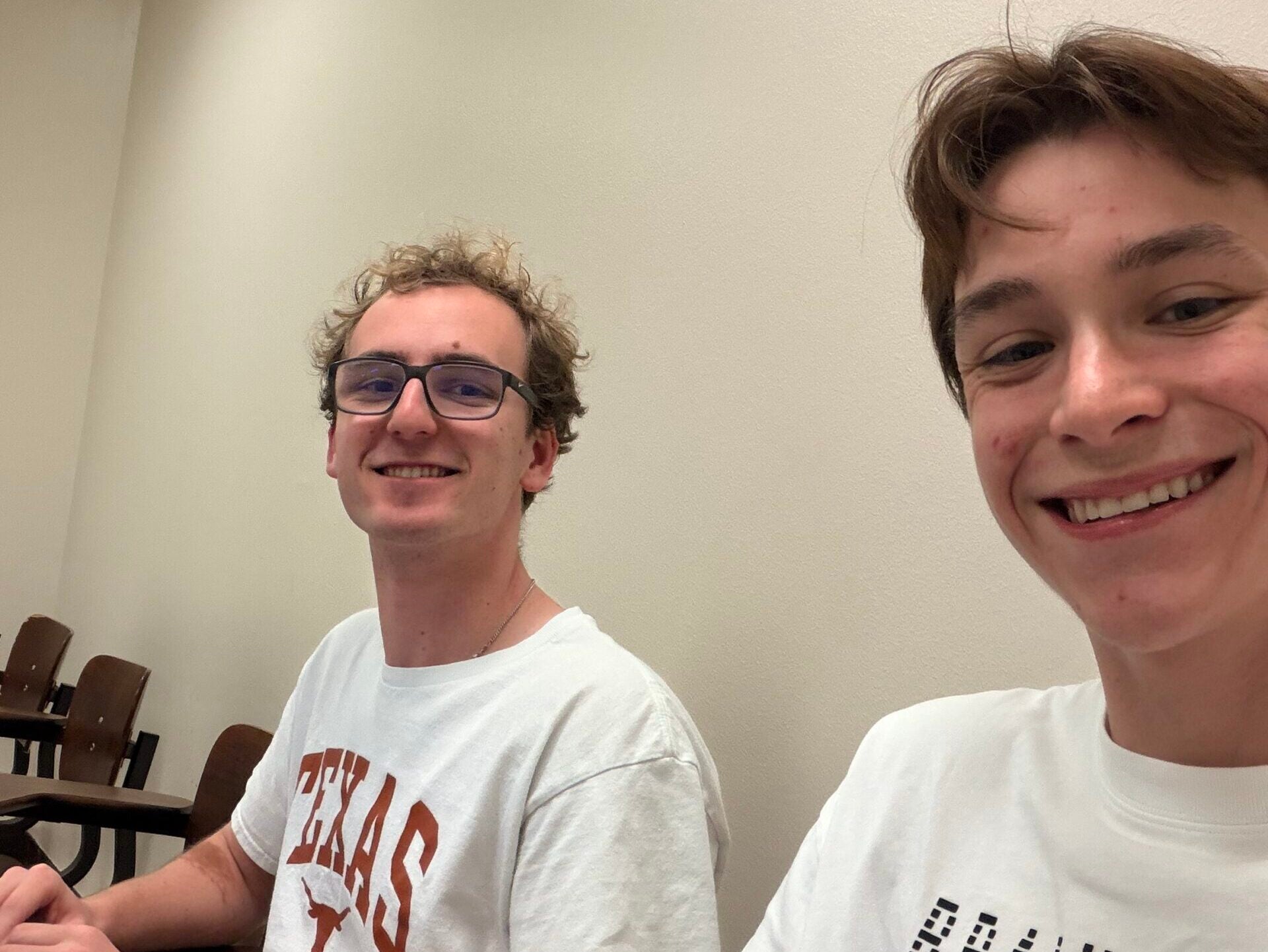
Team TX Filter: Jacob Lucia (Left) and Evan Segura (Right)
Tell us about your concept and how it came to be.
“Our team is working to commercialize research on desalination, in particular, membrane coatings that can help reduce fouling and buildup of silica and other particulates on reverse osmosis membranes while minimizing contaminants that are hard to remove. I was introduced to this research when I started working in Manish Kumar’s membrane lab last spring.
There, I worked on bench-scale testing of the technology and ran fouling tests with our reverse osmosis system. In that lab, I was advised by environmental engineering Ph.D. student Ruizhe Yu, who explained the mechanisms of his research to me and taught me the different types of carbon used during the absorption tests. When I learned about this competition, professor Manish Kumar encouraged me to commercialize the research that Ruizhe and I had been working on for the last 11 months, and here we are.” – Evan Segura
What have you learned through your participation in the competition thus far?
“We’ve had a fantastic time working on the startup project. Throughout this process, I’ve learned so many new skills, such as HTML coding and how to construct the different components needed to construct a website.” – Evan Segura
Team MASLab
Team members: Kelvin Nguyen (Cockrell School of Engineering – Environmental Engineering) and Darin Pi (Cockrell School of Engineering – Civil Engineering)
Tell us about your concept and how it came to be.
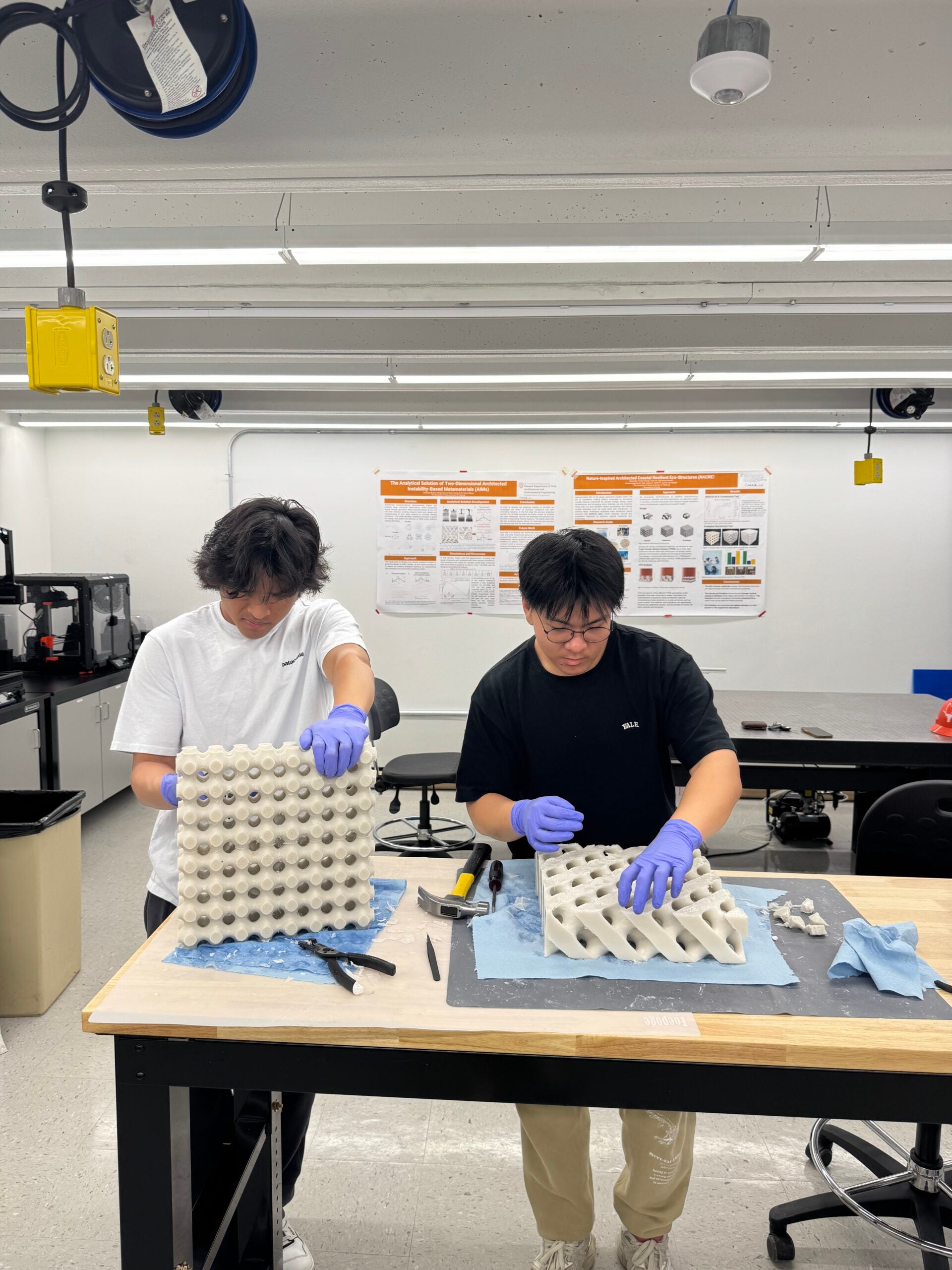
Team MASLab: Kelvin Nguyen (Left) and Darin Pi (Right)
“Our technology, entitled NACRE (Nature-Inspired Architected Coastal Resilient Ecostructures) was developed in response to storm threats, declining natural defenses and loss of coastal habitats and gulf communities. These are all problems that need a solution that works immediately and becomes increasingly effective over time.
Conventional solutions, such as concrete barriers, provide initial protection but deteriorate and harshly compound erosion, destroying shorelines. On the other hand, nature-based solutions like mangroves or marshes take years to mature, which makes it difficult to predict their effectiveness over time.
NACRE tackles both issues with a geometry-driven frame designed to dissipate wave energy and a natural coral material that improves its effectiveness over time by promoting living ecosystems. With LEGO-like constructable reef units, this flexible, modular system can be scaled to fit different coastlines, while both protecting shorelines and helping marine life recover.” – Kelvin Nguyen
What have you enjoyed about the competition thus far?
“I’ve enjoyed seeing how the competition has found a way for every team to have an even playing field. We’ve been exposed to start-up ideas of all different levels and stages, from some concepts that are completely fresh off the minds of undergraduate students, while others are rooted in research that graduate students have been working on for some time.” – Darin Pi
Team HoloIntent
Team members: Junfeng Jiao (School of Architecture – Associate Professor), Christian Claudel (Cockrell School of Engineering – Associate Professor in Civil Engineering), Tianyi Wang (Cockrell School of Engineering – Civil Engineering/Transportation Engineering), Yiming Xu (School of Architecture – Post-Doctoral Researcher), Jiseop Byeon (Cockrell School of Engineering – Civil Engineering), Ahmad Yehia (Cockrell School of Engineering – Civil Engineering/Transportation Engineering), Huihai Wang (School of Architecture – Community and Regional Planning)
Tell us about your concept and how it came to be.

Visualization of the bi-communication layer in augmented and virtual reality
“As robots increasingly enter our workplaces, homes and public spaces, humans need to understand and predict robot behavior to coexist efficiently and safely. There’s a lack of understanding about robot behavior that leads to hesitation in human-robot interaction, which can cause humans to step into a robot’s operating zone and lead to accidents.
To address this problem, we’ve built a bi-directional communication layer between humans and robots that will allow humans to anticipate and prevent unsafe maneuvers, further fostering trust in robot technology. The communication takes place using augmented and virtual reality glass technology. In virtual reality, humans can send commands to the robot through eye gaze, gestures and audio. In augmented reality, humans can see what a robot plans to do and whether it finishes its task.
By making robot behavior visible to humans and human intent understandable to robots, we aim to enable safer collaboration and unlock the potential of robotics in mixed human-robot environments.” – Tianyi Wang
What have you enjoyed about the competition thus far?
“Participating in the Maseeh Innovation Competition has been one of the most meaningful experiences of my time at UT Austin. We were pushed to think beyond coursework, test assumptions rapidly and build something real with real impact. The mentorship and feedback we received helped us refine not just our prototype, but our vision as innovators.” – Tianyi Wang
Team SunUrban
Team members: Kendall Baker (Jackson School of Geosciences – Energy and Earth Resources), Aritro De (School of Architecture – Sustainable Design), Jaehwan Cha (Cockrell School of Engineering – Building Energy and Environments), Tejaswini Kalikiri (Cockrell School of Engineering – Electrical and Computer Engineering)
Tell us about your concept and how it came to be.
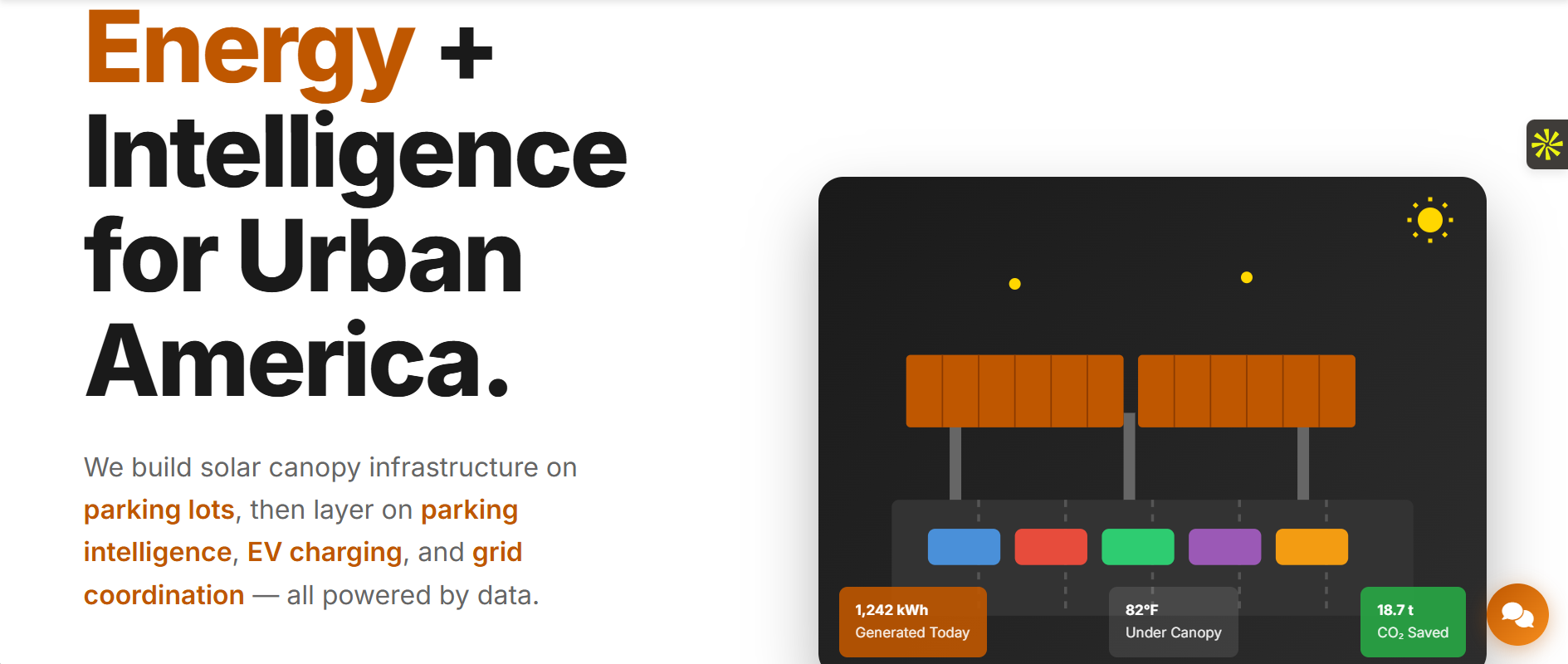
Overview of SunUrban technology
“Our technology, SunUrban, converts existing parking lots into modular coordinated solar microgrids. The system generates clean electricity and lowers urban temperatures.
We combine lightweight thin-film solar panels, smart inverters and battery storage systems. Property owners provide the site with zero upfront investment.
We plan to generate revenue initially through PPAs and, along the way, through a distributed coordinated Virtual Power Plant portfolio and energy market participation. We developed this concept after a team member witnessed a heatstroke incident in an unshaded parking lot during extreme summer heat. Our goal is to build distributed energy infrastructure to supply clean power and cool urban spaces.” – Jaehwan Cha
What have you learned through competition thus far?
“The team collaboration promoted by the competition has allowed us to translate energy theories into engineering solutions.” – Tejaswini Kalikiri